
Today’s topic is building RAG from scratch. Retrieval-Augmented Generation — in Korean, “검색 증강 생성” (search-augmented generation). Just from the term, I had no idea what it meant. So I built it myself and looked inside.
Table of contents
Open Table of contents
- The core idea of RAG
- Getting an OpenAI API key — Anthropic has no embedding model
- 1. Starting with what embedding actually is
- 2. Cosine similarity — how much do two vectors point in the same direction?
- 3. Semantic search — Korean turns out surprisingly low
- 4. Chunk splitting — why it’s necessary
- Retrospective
- Things to study further
The core idea of RAG
Roughly summarized as a diagram:

The core idea is “retrieve documents the LLM doesn’t know about from an external source and feed them in as context.” The unit of that retrieval is a vector (embedding) that compresses the meaning of text, and the comparison is done with cosine similarity.
Getting an OpenAI API key — Anthropic has no embedding model
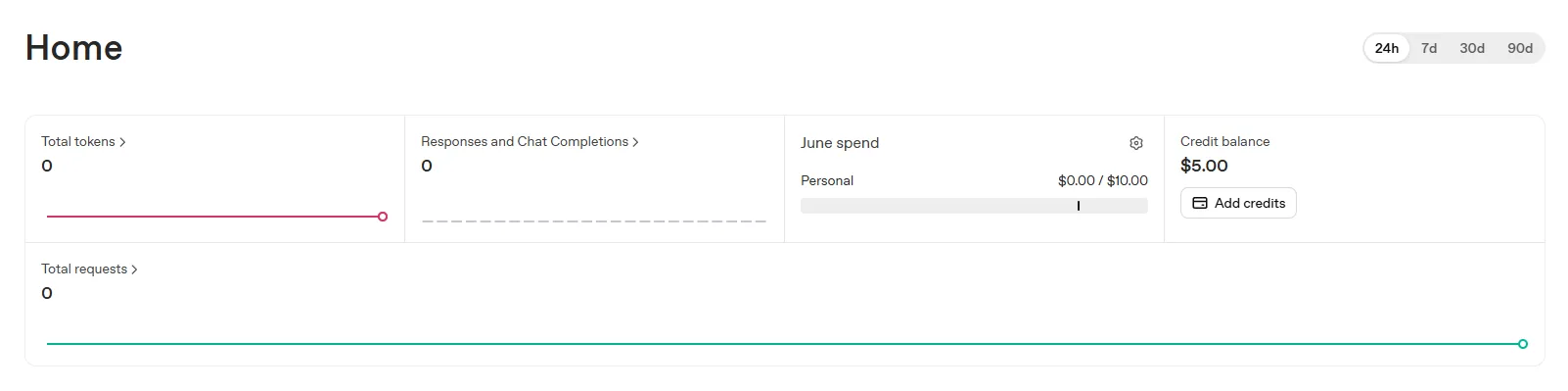
For RAG study, I issued an OpenAI API key. I’d already paid for Anthropic tokens, but apparently for embeddings, OpenAI’s text-embedding-3-small is the cost-effective standard.
- OpenAI embeddings = market standard (the most widely used model)
text-embedding-3-small: $0.02 per 1M tokens- Dimensions: 1536
I’m not sure why, but Anthropic doesn’t build embedding models. They recommend using external models like Voyage AI or Cohere instead. For this study, I went with OpenAI.
1. Starting with what embedding actually is
Code: embedding_basic.py
First, I called the API directly just to get a feel for what embedding is. It’s simply turning text into a vector.
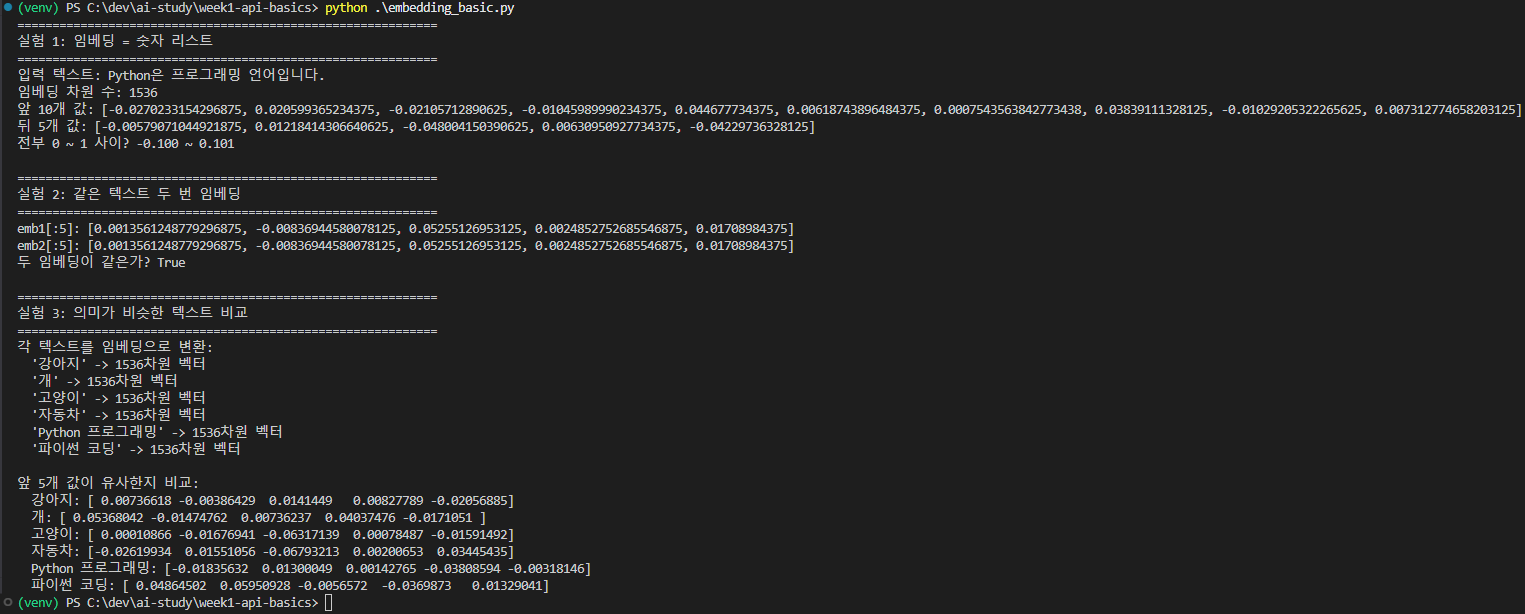
Each piece of text gets converted into a 1536-dimension vector.
But at this point, I couldn’t see why embedding was even necessary. Just turning text into vectors doesn’t tell you how similar two pieces of text are. The next step is the key part.
2. Cosine similarity — how much do two vectors point in the same direction?
Code: cosine_similarity.py
Cosine similarity is a way to measure how similar the direction two vectors point in is. I think I saw this while studying CNNs, but my memory of it is fuzzy.
- Value range: -1 to 1
- Closer to 1 means more similar
- Near 0 means unrelated
- Values near -1 rarely show up in text embeddings
First experiment — suspicious results
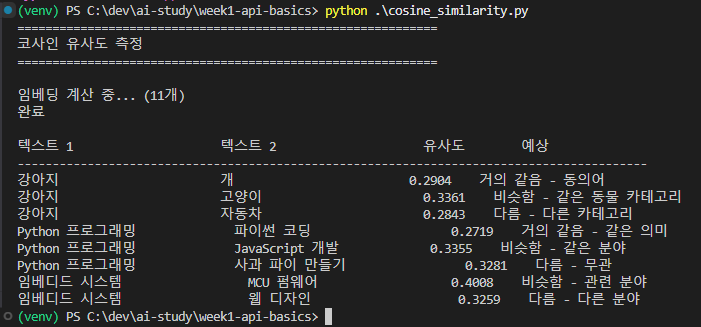
Something’s off. The values look randomly assigned somewhere between 0.2 and 0.4. They weren’t based on similarity at all.
Thinking “maybe it’s a code mistake,” I copy-pasted the whole thing and ran it again, but got the same result. A case with no errors but suspicious results — this turned out to be a really good learning case. I also suspected it might be a temporary issue with the model’s response, but that wasn’t it either.
Hypothesis: embedding a single word alone might not let the model extract meaningful information. So I moved on to the next example with longer text.
3. Semantic search — Korean turns out surprisingly low
Code: semantic_search.py
I tested with a set of longer mock documents plus a list of questions.
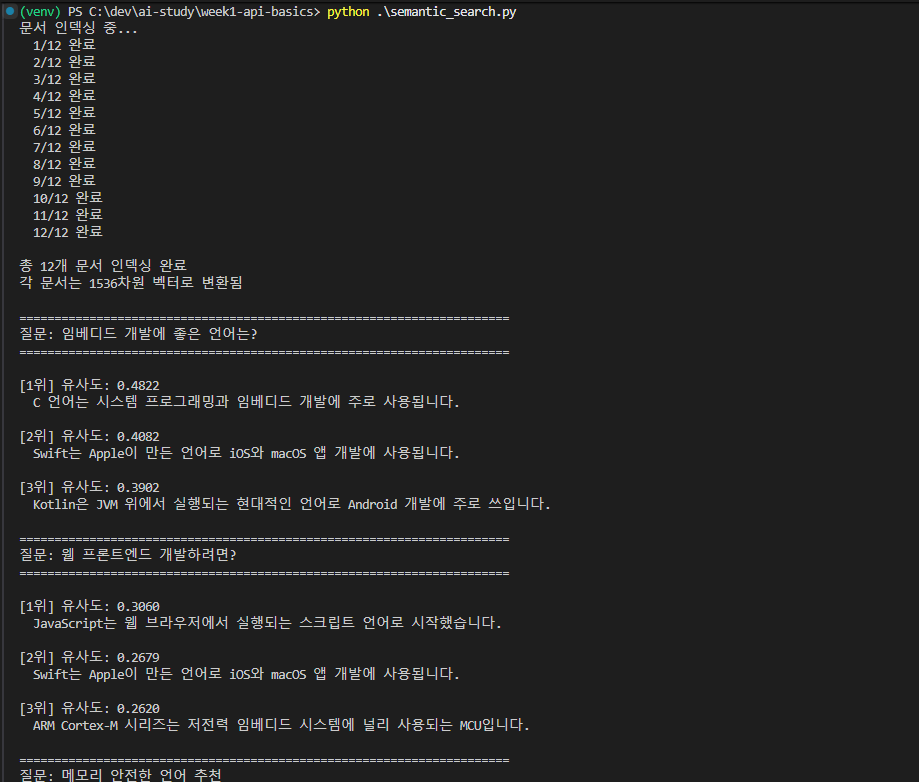
Still lower numbers than expected. This made me question the quality of the answers. Apparently, a good match is generally around 0.6 to 0.8. In this result, the top match was correct, but the 2nd and 3rd were off + even the top similarity was under 0.30 to 0.50.
Possible causes (I noted these down):
- All documents were short sentences, so the semantic information was sparse
- Surface-level expression similarity might be throwing off the actual semantic match
- It could be a limitation of Korean embedding itself
The third one bothered me, so I ran the same experiment in English.
Switching to English
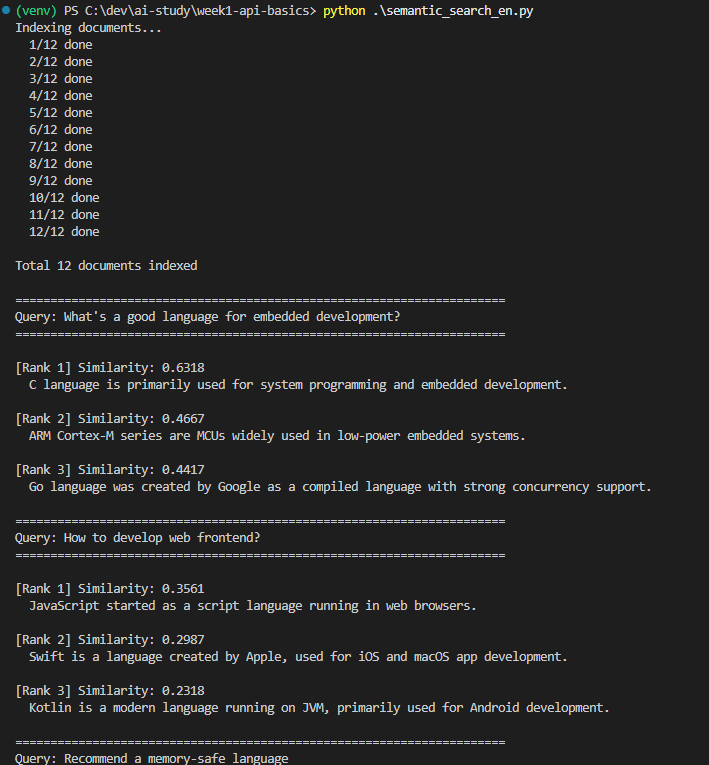
The absolute similarity values were clearly higher, and the match quality was better too. The limitation of Korean embedding was real.
So then — embed in English, respond in Korean — Cross-lingual RAG
The thought naturally followed:
Wouldn’t it make sense for a real service to embed in English, then translate to Korean for the response?
Looking into it, this pattern already exists: Translation-based Retrieval, or Cross-lingual RAG.
| Pros | Cons | |
|---|---|---|
| English embedding + Korean translation | Higher embedding quality | 5x increase in latency (two translations + embedding) |
| Korean-specific embedding (KoSimCSE, etc.) | Lower latency | Trade-off in model quality + dimensions / hosting cost |
The operating cost itself doesn’t increase as much as I expected, but the 5x latency is the real blocker. I figured it would be better to just try a Korean-specific embedding model separately instead.
Additional observation: it seems like there’s a tendency for the model to mark something as more similar just because keywords happen to match. That said, for longer documents, I’d expect context-based matching to kick in, so retrieval should work better.
4. Chunk splitting — why it’s necessary
Code: chunk_search.py
In practice, documents are long. A whole book, an entire paper PDF, a whole codebase. If you embed the whole thing at once, the meaning gets blurred.
Intuition — what happens if you embed an entire book on embedded systems?
The average of each chapter ends up landing somewhere around “embedded development” in general. So even if you ask “When should I introduce an RTOS?”, it can’t find the vector that matches that.
→ You need to split it into chunks and embed those, so that the RTOS-related chunk gets captured separately.
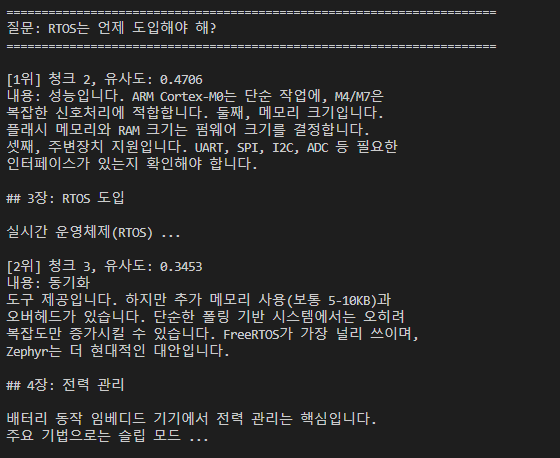
In this example too, the absolute similarity values weren’t large, but the top-ranked answer matched correctly every time.
Chunk size trade-off
| Chunk size | Precise matching | Context | Noise |
|---|---|---|---|
| Small | ✅ | ❌ Lost | ❌ None |
| Large | ❌ | ✅ Preserved | ⚠ Increases |
General recommendation: 256 to 512 tokens (roughly 500 to 1000 characters for Korean).
Retrospective
To sum up today in one line:
Embedding is just vector conversion. Meaning is measured with cosine similarity. Long documents need to be split into chunks.
Two things stood out the most:
-
A case where there’s no code error but the result is strange — this was a good case for getting a feel for how to debug when the model’s output itself seems suspicious. The debugging pattern of changing variables, like single word vs. sentence length, or Korean vs. English.
-
Actually observing the weakness of Korean embedding — instead of vaguely hearing that “Korean is weaker,” I confirmed it directly through numbers like 0.3 vs. 0.7. I now understand why English embedding + translation (Cross-lingual RAG) became a common pattern.
Things to study further
1. The principles behind embedding (my open question)
- The mechanism by which Transformers turn text into vectors — token embedding → attention → pooling
- The evolution from Word2Vec / GloVe → BERT / Sentence-BERT → OpenAI Ada / text-embedding-3
- What the dimensions mean — what each of the 1536 dimensions represents (in reality, uninterpretable, determined through training)
- I want to organize this properly at some point, whether through videos or papers
2. Korean-specific embedding models
- KoSimCSE / KoSBERT — the de facto standard for Korean sentence embedding
- multilingual-e5-large — a multilingual model with decent Korean performance
- Voyage AI multilingual — a commercial option
- Comparing Korean embedding model benchmarks (KLUE-STS, etc.) against OpenAI
3. Vector DBs
- pgvector (Postgres + vector extension) — supported natively by Supabase
- Pinecone / Weaviate / Chroma / Qdrant — dedicated vector DBs
- HNSW vs IVF indexing algorithms
- The trade-off between simply computing cosine similarity with numpy vs. ANN search in a vector DB
4. Chunk splitting strategies
- Fixed-size chunking — simply splitting every N tokens
- Recursive Character Splitter — breaking down paragraph → sentence → word order (the LangChain standard)
- Semantic Chunking — splitting at semantic boundaries (slower but higher quality)
- Sliding Window + Overlap — preserving context between chunks
- Experimental methods for finding the optimal chunk size + overlap
5. Hybrid search — keyword + semantic
- Vector search alone doesn’t do well with proper nouns / exact code / typos
- Combining BM25 (traditional keyword search) + vector search = Hybrid
- Reciprocal Rank Fusion (RRF) — a method for merging the rankings of two search results
- Elasticsearch, Weaviate, and others support hybrid search as a first-class feature