
What I learned today is error handling + retry. This is the very first piece of infrastructure you need to lay down to run a reliable, accurate LLM service.
Table of contents
Open Table of contents
- 1. LLM API errors fall into 4 categories
- 2. Which errors am I responsible for handling
- 3. Stage 1 — Basic try-except wrapper
- 4. Stage 2 — Exponential Backoff retry
- 5. Stage 3 — What the Anthropic SDK handles for you
- 6. Stage 4 — JSON response validation (handling LLM format violations)
- Retrospective
- Things to study further
1. LLM API errors fall into 4 categories
Not all errors I have to handle are the same. Since cause → response method differs, I need to classify them first.
Transient errors — resolved by retrying
| Error | Meaning |
|---|---|
| RateLimitError (429) | Calling too fast. Retry after a moment |
| APIConnectionError | Temporary network disconnection |
| APITimeoutError | Response took too long |
| InternalServerError (500) | Temporary problem on Anthropic’s servers |
→ Worth retrying.
Permanent errors — retrying is pointless
| Error | Meaning |
|---|---|
| AuthenticationError (401) | Wrong API key |
| PermissionDeniedError (403) | No permission |
| BadRequestError (400) | Malformed request |
| NotFoundError (404) | Wrong model name |
→ Code / config needs fixing. Retrying is a waste of time.
Related to user input
- Input tokens exceed the context window
- Blocked due to unsafe content
→ Validate on the input side / ask the user again.
Related to response format (the LLM’s own issue)
- Asked for JSON but got something that isn’t JSON
- Tool call arguments don’t match the schema
- Response gets truncated (hits
max_tokens)
→ Not technically an error, but the format is off. Needs extra validation + retry.
2. Which errors am I responsible for handling
| Category | Responsibility |
|---|---|
| Permanent errors | Almost always my code’s fault — fix from the start |
| User input related | Input validation / UX handling |
| Transient errors | Handling these well is what makes stable operation possible ✅ |
| Response format related | Handling these well is what makes stable operation possible ✅ |
In other words, transient errors + response format issues are my responsibility. I learned how to deal with these two through a 4-stage example.
3. Stage 1 — Basic try-except wrapper
In practice, you create a wrapper function that wraps the API call. You attach an except for each error you might encounter and handle it:
- Transient errors → sent to the retry logic
- Permanent errors → print exactly what kind of error occurred so the code can be fixed easily
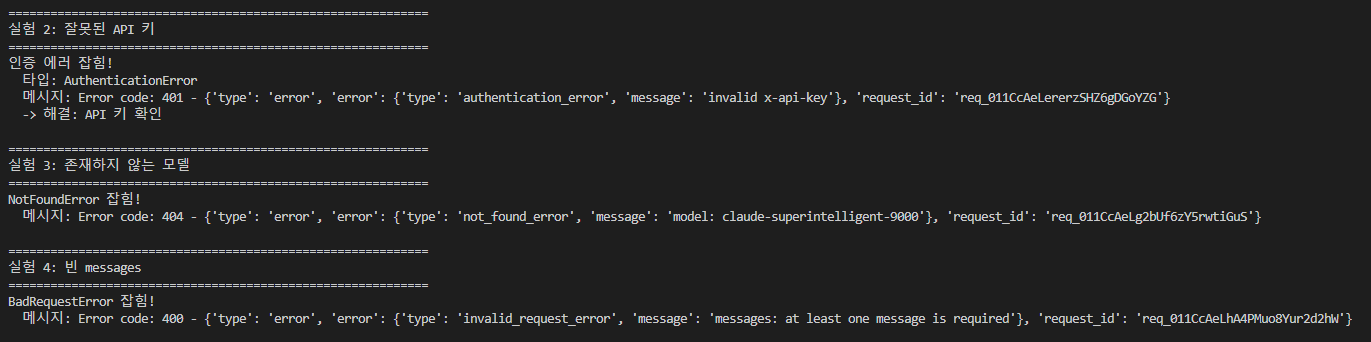
The key point is: “never leave it ambiguous what error occurred.” Not being able to debug is the biggest cost.
4. Stage 2 — Exponential Backoff retry
For transient errors, this is the retry pattern. You shouldn’t just retry immediately — if many clients retry at the same moment, it can cause even more load (the “thundering herd” problem).
The solution:
- Increase the wait time exponentially based on the number of attempts (1s → 2s → 4s → 8s …)
- Add jitter (noise) to spread out the retry timing
This is called the Exponential Backoff with Jitter pattern.
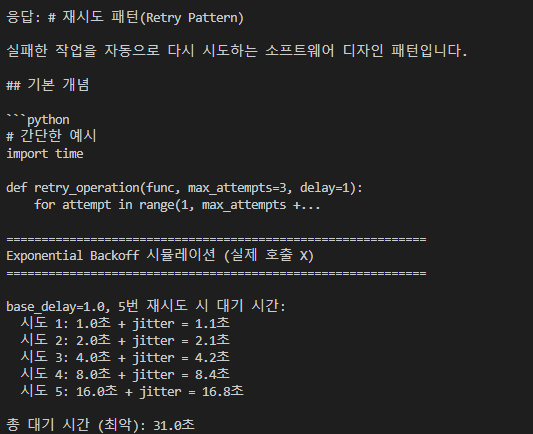
This pattern isn’t limited to LLM APIs — it’s the standard for all external API calls. AWS SDK, Google Cloud SDK, and others all use this pattern too.
5. Stage 3 — What the Anthropic SDK handles for you
You can write manual retry code, but the Anthropic SDK retries by default.
- Transient errors are automatically retried by the SDK
- Permanent errors are not retried (since it wouldn’t be meaningful)
- The exponential backoff built above is also automatically applied
In other words, for simple calls or standard error handling, you can just leave it to the SDK.
There are still cases where manual retry logic is needed:
- Special retry logic (e.g., retrying after changing the model or modifying the prompt)
- Extra actions between retries (logging, alerts, notifying users)
- Different handling after N retries (fallback response, returning a cached response, etc.)
For these cases, you need to write it manually.
6. Stage 4 — JSON response validation (handling LLM format violations)
The last case is when it’s not technically an error, but the LLM violates the format. When you asked for a JSON response but got a different format, how do you track it and trigger a retry?
The validation logic I built:
- Extract only the JSON portion from the LLM’s response
- Check that all required fields are present
- Check that each field’s type is correct
- Check that values fall within a predictable range
- If everything passes, return
(True, data), and on the output side, extract just the key values and display them clearly
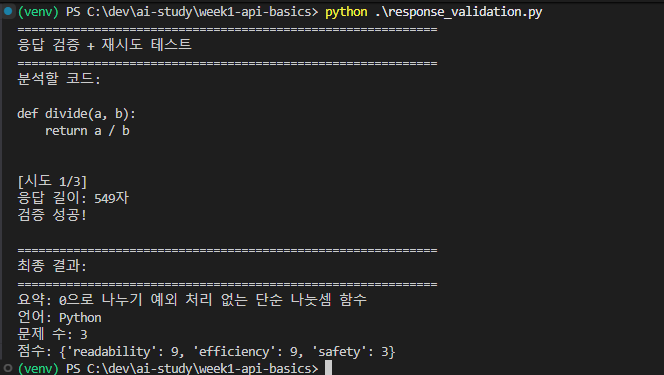
This time it passed on the first attempt, but if the response had come back in the wrong format or with out-of-range values, it would have automatically retried.
This pattern is a step you must go through before passing LLM output on to downstream systems (DB, API, another LLM call). A single format violation can break the entire system downstream.
Retrospective
After going through the 4-stage error handling + retry example, here’s what I think:
To build a reliable, accurate LLM service, this infrastructure is what you need first. Making sure responses arrive consistently, no matter the situation, comes before making the model smarter.
What I found particularly interesting was the sense of “controlling the responses for the service I’m building.” When an LLM response violates the format, instead of just accepting it as-is, you run it through a validation-and-retry cycle that forces it to conform to the schema I defined. I think this is what “integrating an LLM into code” really means.
Things to study further
1. The Anthropic SDK’s exact retry policy
- Default
max_retriesvalue (for the Python SDK) - The exact list of which status codes are retried
- Customizing retry count via
client.with_options(max_retries=N) - Anthropic SDK errors and retries official docs
2. Types of jitter — Full / Equal / Decorrelated
- Full jitter:
sleep = random(0, base * 2^attempt) - Equal jitter:
sleep = base * 2^attempt / 2 + random(0, base * 2^attempt / 2) - Decorrelated jitter: recalculated based on the previous sleep value
- AWS’s official blog post “Exponential Backoff And Jitter” is the standard reference
3. Safer ways to force JSON responses
- Just telling it “answer in JSON” via prompt is a weak guarantee
- JSON mode / structured output — some models can enforce a schema
- Using Tool Use’s input_schema for response validation
- Pydantic + the Instructor library — practically the standard in Python
4. Circuit Breaker pattern
- After a certain number of consecutive failures, block calls entirely for a period of time
- Prevents the caller from wasting time/money on infinite retries
- A pattern that’s used alongside retry
- Netflix Hystrix, Resilience4j, etc. are well-known implementations
5. A retry strategy that factors in cost
- Every retry uses tokens = costs money
- The decision of “is this error worth retrying?”
- UX for notifying the user that a “retry is in progress”
- Fallback response on final failure (cache / static response / cheaper model)