
Following Eval Study #1 (Accuracy + LLM-as-Judge), today’s topic is similarity-based evaluation + test set design principles.
Table of contents
Open Table of contents
- Where the Three Evaluation Methods Fit
- Starting the Experiment — and a Sense for Choosing Embedding Models
- Comparing Two Embedding Models — An Unexpected Finding
- A Real Example — All 4 Fail (But the Real Problem Is Formatting)
- Test Set Design — 5 Principles
- Terminology Correction — It Wasn’t a “Regression Test”
- Reflection
- What to Study Further
Where the Three Evaluation Methods Fit
Let me lay out the two axes I organized earlier, plus a new one:
| Method | When to use it |
|---|---|
| Accuracy-based | When the correct answer is clear (tool selection, classification) |
| LLM-as-Judge | For subjective evaluation where there’s no single fixed answer |
| Similarity-based | When there’s a correct answer, but it can be expressed in various ways |
Today I’m covering the third one — comparing an expected answer to the actual output using embedding similarity.
Starting the Experiment — and a Sense for Choosing Embedding Models
While typing out the example code, I noticed it used text-embedding-3-small as the embedding model. This reminded me of the issue I ran into in a previous RAG post — this model does well picking top-K results for English, but for Korean, the absolute similarity values are low and it has poor discriminative power.
Once you’ve accumulated experience like this, you start noticing what needs to change before blindly copying code. I think this is exactly why, even as more code gets written with AI assistance these days, the value of a senior developer actually goes up — the sense of knowing which parts to adjust for your specific situation when the AI spits out a probabilistically plausible answer becomes more important. Rather than vaguely thinking “I should study more,” this is the first concrete direction I’ve spotted here.
But First — Quantify Before Swapping
Instead of going with “I feel like this one was worse”, I first check numerically how the two models actually differ. This is the same principle I learned first while studying Eval.
Comparing Two Embedding Models — An Unexpected Finding
I embedded the same question-answer pairs using text-embedding-3-small (OpenAI) vs bge-m3 (Ollama) and computed similarity.
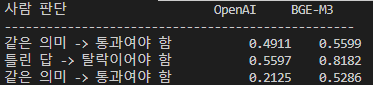
Both models gave the highest score to the “wrong answer.” OpenAI 0.5597 / BGE-M3 0.8182. The correct answer with the same meaning actually scored lower (0.4911 / 0.5599).
The Fundamental Limitation of Similarity-Based Evaluation
Digging into why makes it clear:
Similarity captures “topical and expressive closeness,” not “the content of the answer.”
For the same question, an answer that’s “wrong but packed with vocabulary related to the topic” can score higher than an answer that’s “correct but phrased differently in a condensed way.” That’s because embeddings measure distance in a semantic space of vocabulary and structure — not logical truth or falsehood.
Reproducibility + Isolation Experiments
To check whether this result was a fluke, I ran a few more cases:
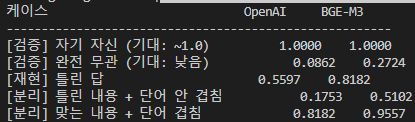
Observations:
- Self-comparison: 1.0 (as expected)
- Completely unrelated: 0.086 / 0.272 (expected: low ✅)
- Reproduction (the earlier wrong answer): 0.560 / 0.818 (reproduced)
- Isolation (wrong content + no word overlap): 0.175 / 0.510 (low ✅ correctly caught)
- Isolation (correct content + word overlap): 0.818 / 0.956 (high ✅ correctly caught)
Whether the words themselves overlap overwhelmingly determines the similarity score. This makes it clear why “wrong but stuffed with related vocabulary” got a high score earlier.
Can’t Judge Which Model Is Better From This Data Alone
OpenAI’s score range is wider (0.09 ~ 0.82), which makes it look more discriminative, but bge-m3 simply has a higher baseline (0.27 ~ 0.96), so its scores as a whole sit higher up. Which one is actually better can’t be determined from this table alone — a proper evaluation would need a separate benchmark.
A Real Example — All 4 Fail (But the Real Problem Is Formatting)
Going back to the example, I evaluated answers to 4 questions using similarity-based scoring:
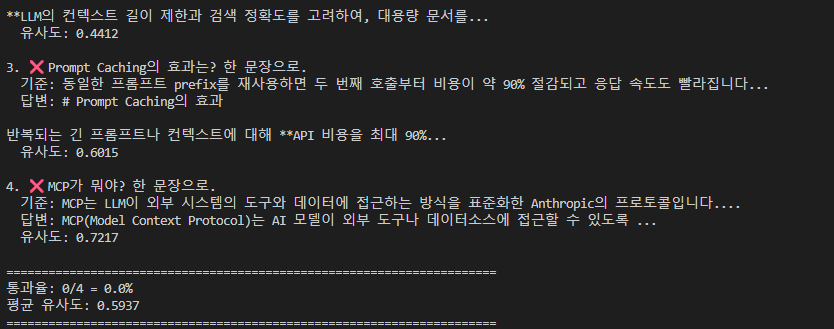
I thought a pass rate of 0/4 meant disaster, but looking closer:
- The threshold just wasn’t met — in practice, the top-ranked answers were all pointing in the right direction
- The LLM’s response included markdown headings, bold text, and line breaks, which shifted the embedding vector’s direction away from the reference answer
- In other words, even when the content is correct, differences in formatting alone can drag similarity down
So the Practical Standard — Combining Similarity + LLM-as-Judge
If you use similarity alone:
- Correct answers get failed just because of formatting differences
- Wrong answers padded with related vocabulary get passed
→ Combining similarity with LLM-as-Judge is the practical standard. Similarity does the first-pass filtering, and the LLM makes the final call on content logic.
Test Set Design — 5 Principles
No matter how well-designed the Eval is, if the test set itself is biased, it’s all pointless. Here are 5 principles:
1. Reflect the Actual Usage Distribution
Assemble a diverse set of questions that resemble what would actually come up in the real usage environment. If you only accumulate artificial cases made for development convenience, you can’t predict production performance.
2. Include Edge Cases
Normal cases alone aren’t enough. Be sure to include:
- Requests for data that doesn’t exist
- Ambiguous questions
- Out-of-scope questions
- Prompt injection attempts
3. Stratify by Difficulty
Manage cases by splitting them into Easy / Medium / Hard. Looking at scores by tier makes it clear where improvement is needed — a breakdown like “easy 100%, medium 60%, hard 20%” clearly tells you where to dig in.
4. Start Small
Don’t try to build something perfect with 10,000 cases from the start. First secure a scale you can actually test with, then add cases each time you discover one that fails. That’s what makes a living evaluation set.
5. Make the Correctness Criteria Explicit
- Which tool must be used
- Which words must be included
- Which words must not be included
Document these explicitly. A vague standard like “this is roughly correct” will make the evaluator’s judgment waver every time.
Terminology Correction — It Wasn’t a “Regression Test”
Afterward, I worked through an example comparing V1, which had a sloppily written description, and V2, which had a clearly written one. At first I called this a “regression test” — but the regression test concept I knew was different, so something felt off and I asked again.
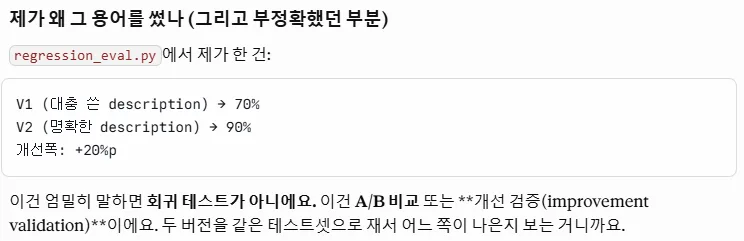
The answer:
Regression Test — when existing code is modified, checks whether performance has gotten worse than before the change
Improvement Validation / A/B Comparison — measures two versions against the same test set to determine which one is better
What I understood a regression test to be was correct, and the example code had simply mislabeled it. Mixing up even a single term like this can lead to communication errors in real-world operations.
V1 vs V2 Results
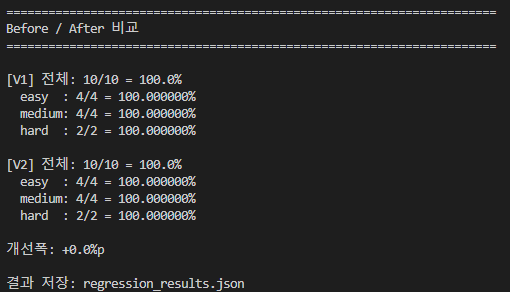
In this particular example, tool selection accuracy was 100% / 100% regardless of whether the description was sloppy or clear. The example itself was too easy. This isn’t enough data to confirm the principle that, in practice, a more specific description makes the system stronger on harder problems.
Still, I got a hands-on feel for how the “measure → improve → re-measure” cycle actually runs.
Reflection
Three things I took away from today’s study:
- The pitfall of similarity-based evaluation — it captures closeness in vocabulary and expression, not content. I actually observed a pass rate of 0/4 caused by nothing more than markdown formatting. In practice, combining similarity with LLM-as-Judge is the answer.
- 5 principles of test set design — usage distribution / edge cases / difficulty tiers / starting small / explicit correctness criteria. A living evaluation set is the key.
- The importance of verifying terminology — the more common a term like “regression test” is, the more it needs to be verified when you’re copying example code. If I had just glossed over this, it would have led to communication errors on a team later.
What to Study Further
1. Embedding Model Benchmarking — Quantitative Comparison
- Today I only got a rough feel from 5–7 cases. A proper benchmark would use datasets like KLUE-STS or MTEB (Massive Text Embedding Benchmark)
- Compare OpenAI
text-embedding-3-small/largevsbge-m3vsKoSimCSEvsmultilingual-e5on real-world Korean tasks - A method for normalizing the baseline similarity before comparison (z-score normalization)
2. A Combined Similarity + LLM-as-Judge Pipeline
- Determining the threshold for the first-pass similarity filter (too lenient lets wrong answers through / too strict fails correct answers over format differences)
- Whether it’s useful to pass the similarity score itself as context to the second-pass LLM-as-Judge
- How tools like RAGAS / DeepEval implement this combination
3. Format Normalization
- Converting markdown to plain text before embedding
- Stripping out bold/line break/heading syntax
- Measuring how much this stabilizes similarity scores in practice
4. An Edge Case Catalog
- “Requesting data that doesn’t exist” — does the LLM hallucinate an answer, or respond with “no data available”?
- “Prompt injection” — attempts to disable the system prompt
- “Mixed languages” — does it answer only in English to a Korean question?
- Cataloging edge cases that come up frequently by domain
5. Applying Real Eval to a RAG System
- Layering today’s combined similarity + LLM-as-Judge pipeline onto the FEMS RAG I built recently
- Measuring retrieval (Hit Rate @ K, MRR) and generation (Faithfulness, Answer Relevance) separately
- Actually running the measure → improve (chunking / embedding / prompt) → re-measure cycle
6. Understanding Backend / WAS
- For an Eval system to be part of CI, it eventually needs to run as a server
- Getting a feel for building a WAS with Django / FastAPI / Node
- Ways to view Eval results on a dashboard (Grafana / custom UI)
- The picture of server-side work being layered on top of the systems sense I built up during my embedded days